Demolitions Cyprus executed the controlled structural deconstruction of a reinforced concrete facility in Nicosia, Cyprus, deploying a CAT 336 excavator with hydraulic breaker, MB crusher bucket, and high-pressure atomised dust misting cannons. Spanning 14 working days, the mechanical demolition diverted 94% of non-structural concrete and structural steel in full compliance with the Cyprus Department of Labour Inspection (DLI).
Situated within the industrial commercial zone of Nicosia, this structural deconstruction project required the selective mechanical demolition of a multi-bay reinforced concrete building spanning a 45,000 m² footprint. Demolitions Cyprus acted as principal demolition contractor, operating under strict site safety guidelines approved by the Nicosia District Organisation of Local Government (EOA Nicosia) and the Department of Labour Inspection (DLI) pursuant to Safety and Health at Work Law 89(I)/1996 and K.Δ.Π. 412/2015. Learn more about our specialized capabilities via our Industrial Demolition in Cyprus portfolio.
The engineering challenge centered on the close proximity of an active commercial distribution depot situated immediately along the eastern structural perimeter. Demolitions Cyprus established an active zero-vibration boundary monitoring program using triaxial geophone seismographs to protect adjacent operational foundations while systematically reducing reinforced concrete superstructures. For complex structural projects, we regularly coordinate safe execution protocols as detailed in our Safe Structural Demolition Services in Nicosia review.
Mechanical dismantling followed a top-down, non-explosive structural demolition sequence engineered to prevent premature collapse and control lateral kinetic release:
Urban deconstruction within Nicosia requires rigorous adherence to the Control of Atmospheric Pollution Regulations. Demolitions Cyprus positioned specialized mobile high-pressure misting cannons delivering atomised water droplets (30–50 microns) directly onto the hydraulic breaker impact point. This immediate point-of-fracture wetting suppressed crystalline silica and cement dust plumes without creating saturated slurry runoff. Further insights into full site clearing methodologies are available in our Industrial Demolition & Factory Site Clearance case study.
Ground-borne vibration levels were logged continuously along perimeter boundaries. Peak Particle Velocity (PPV) was kept strictly under 3.0 mm/s, well below standard structural threshold limits, ensuring zero downtime or structural risk for neighboring commercial facilities.
In accordance with the Waste Law 185(I)/2011 and K.Δ.Π. 159/2017 for Construction and Demolition (C&D) Waste Management, Demolitions Cyprus converted clean reinforced concrete into certified secondary aggregate on site using an excavator-mounted MB Crusher Bucket.
Crushing structural concrete directly on site eliminated 42 heavy haulage truck transits across Nicosia municipal transit corridors. Powerful electro-magnets extracted all internal rebar and structural steel reinforcement, delivering clean ferrous metals to authorized metal recycling facilities in Nicosia District. Review our broader service framework on our Experts Commercial Demolition page.
| Material Stream | Classification | Processing Method | Diversion / Recovery Rate |
|---|---|---|---|
| Reinforced Concrete Slabs & Footings | Non-structural Mineral Waste | Mechanical Fracturing & On-Site MB Crusher Bucket | 94% (Certified Recycled Sub-Base) |
| Structural Steel & Rebar Reinforcement | Ferrous Metal | Hydraulic Shearing & Magnetic Source Separation | 100% (Recycled via Nicosia Steel Processors) |
| Masonry & Ceramic Aggregate | Inert C&D Material | Sorting, Impact Screening & On-Site Backfill | 92% (Reused for Ground Levelling) |
| Mixed Non-Structural Residuals | General Inert Waste | Segregated Bin Loading & Transfer to Licensed Facility | Site Waste Minimised (<6% Landfilled) |
Demolition of an industrial building in Nicosia requires an official Demolition Permit issued by the Nicosia District Organisation of Local Government (EOA Nicosia) under Streets and Buildings Regulation Law Cap. 96. Contractors must submit structural demolition methodologies, traffic control schemes, and health and safety plans approved by a Cyprus Scientific and Technical Chamber (ETEK) registered civil engineer. Work can only initiate following verified notifications submitted to the Department of Labour Inspection (DLI) under K.Δ.Π. 412/2015.
On-site concrete crushing in Nicosia is governed by Waste Law 185(I)/2011 and C&D Waste Management Regulations K.Δ.Π. 159/2017 overseen by the Department of Environment. Operators must utilize certified equipment, employ continuous dust suppression misting, and ensure crushed aggregate meets secondary construction material specifications for sub-base applications. In this Nicosia project, processing concrete on site eliminated 42 heavy truck journeys through municipal roads while diverting 94% of mineral waste.
Demolition within urban Nicosia mandates continuous dust suppression at point-of-fracture using high-pressure atomised misting systems under Cyprus atmospheric pollution standards. Vibration monitoring via real-time seismographs must maintain Peak Particle Velocity (PPV) below defined safety limits to safeguard adjacent operational assets and boundary structures. Demolitions Cyprus implements boundary acoustic barriers, directional mist cannons, and low-frequency hydraulic attachments to secure full compliance.
Utility cut-offs require formal termination certificates issued by the Electricity Authority of Cyprus (EAC) and the Nicosia Water Board prior to physical deconstruction. Isolation seals and safe-working clearance notices must be verified on site by the demolition project engineer before heavy excavators make initial impact. Written approvals are archived in the construction safety file in compliance with Department of Labour Inspection enforcement protocols.
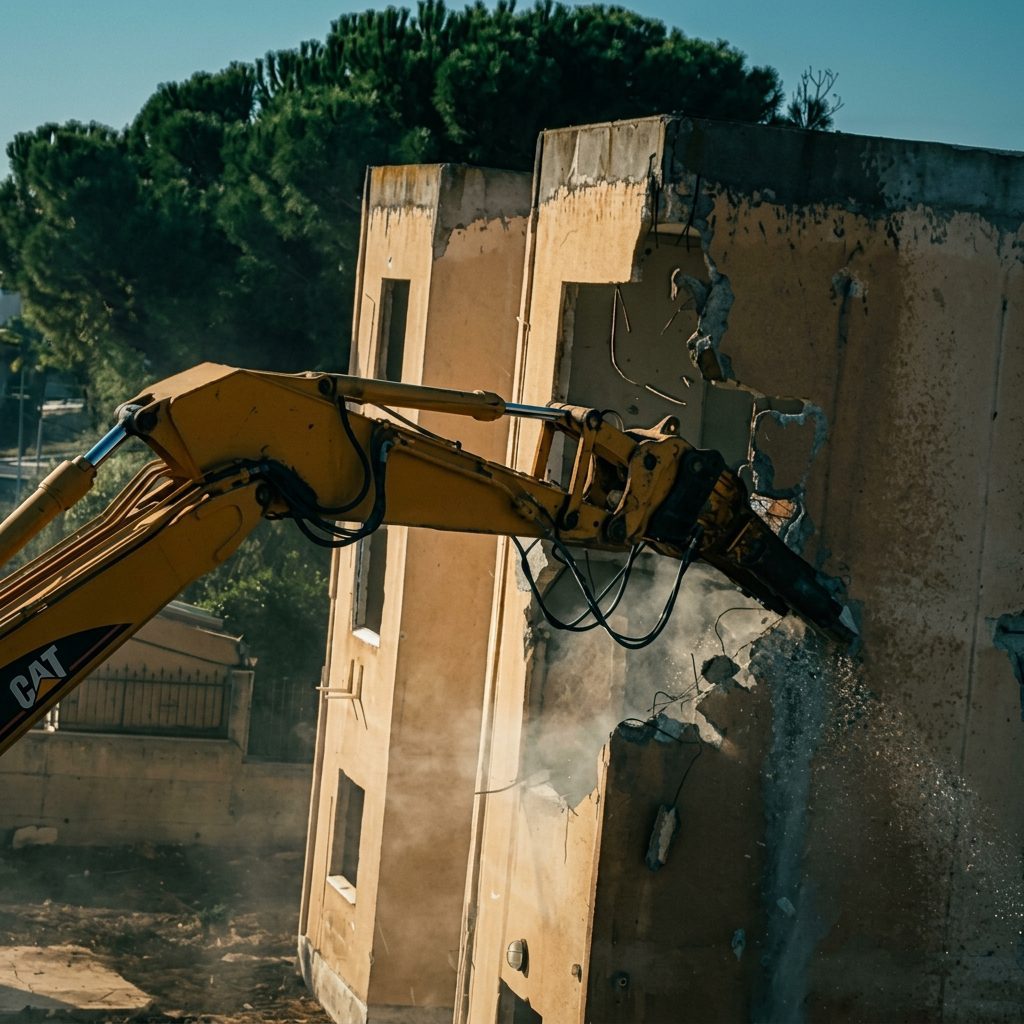
Engineers conducting structural risk assessment, zero-vibration perimeter calibration, and internal non-structural clearing in Nicosia.
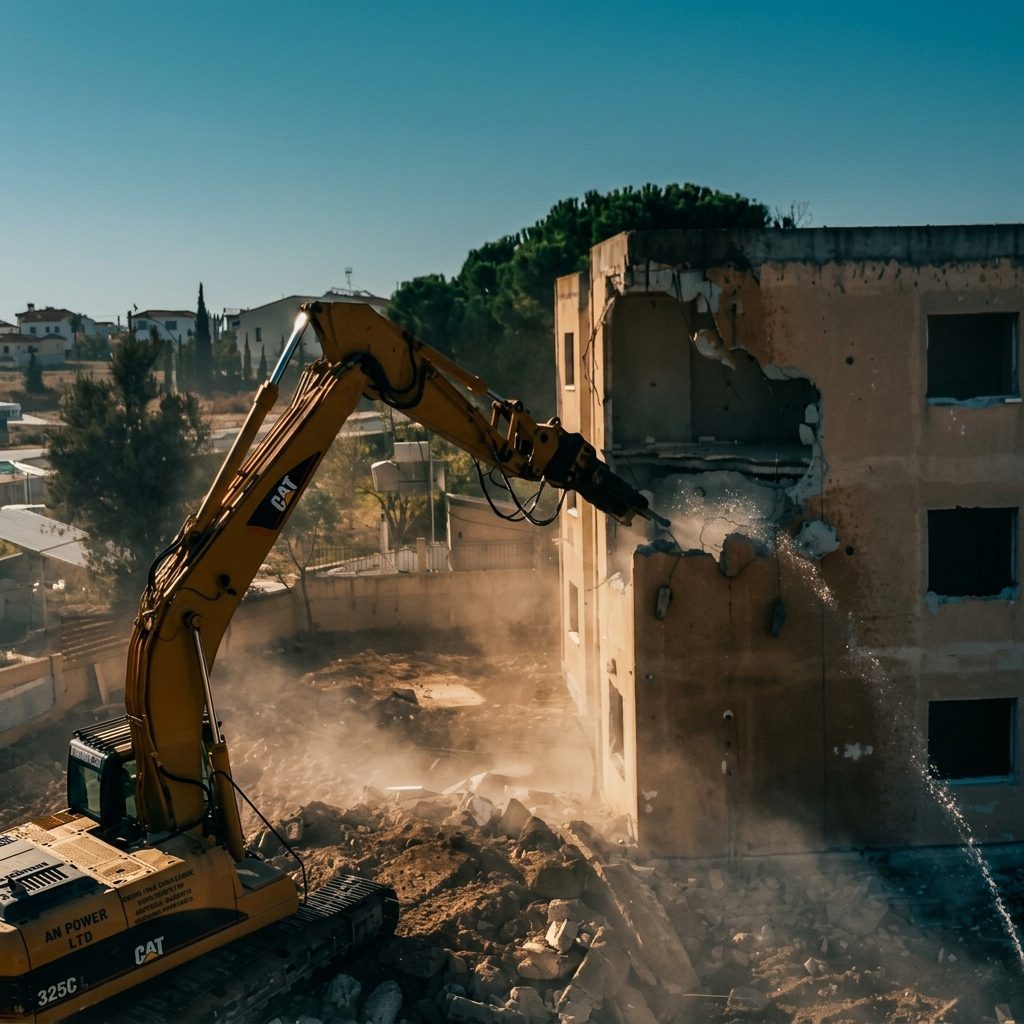
CAT 336 excavator executing top-down hydraulic breaker demolition with active high-pressure dust suppression misting.
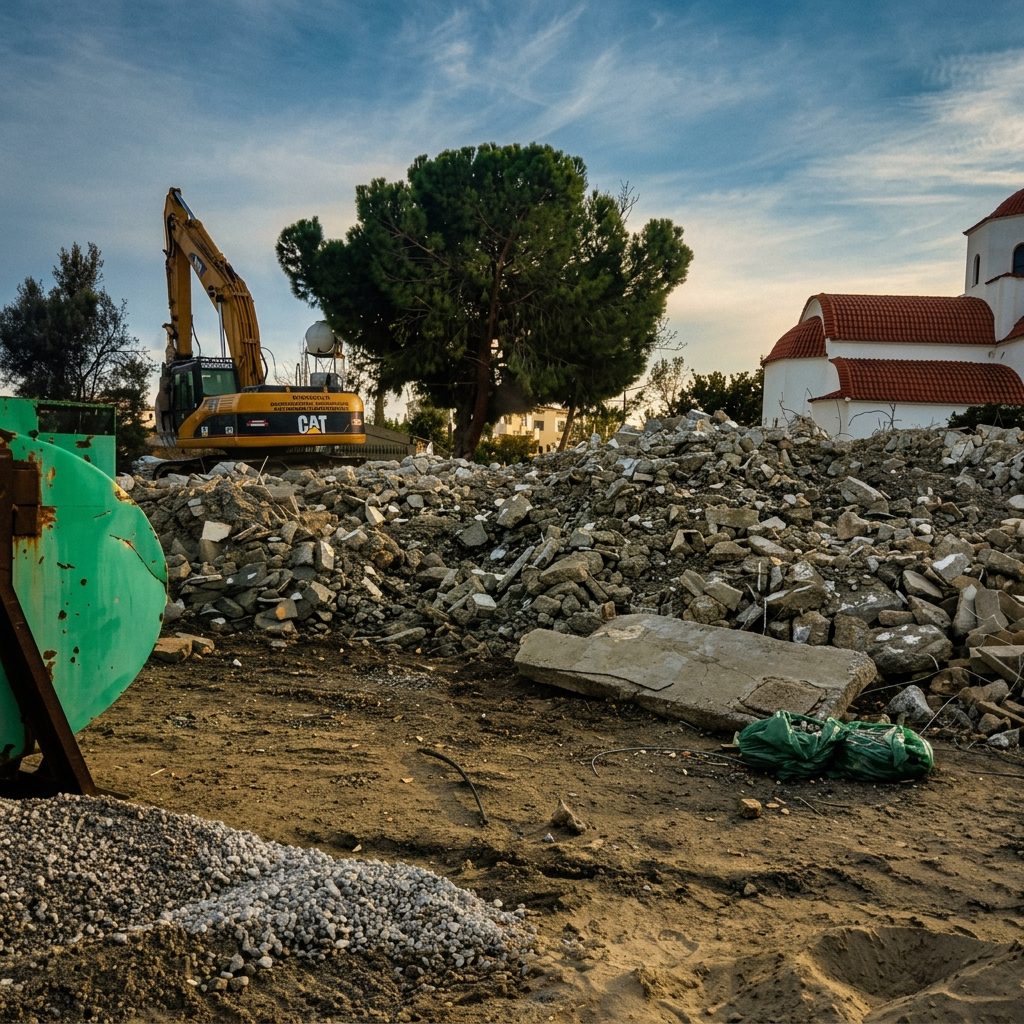
MB Crusher Bucket processing reinforced concrete aggregate on site, magnetic steel recovery, and final grade handover in Nicosia.